
Why Was Protein Never Mentioned in Ayurveda?
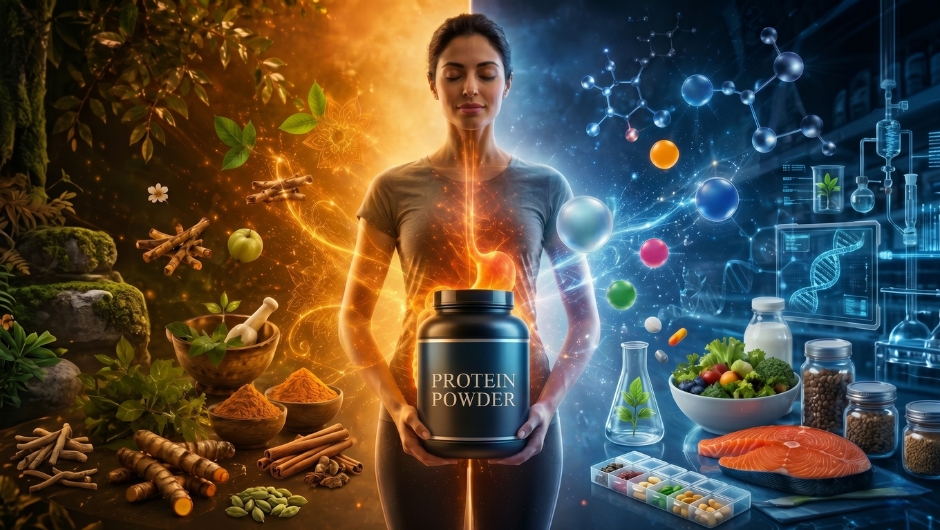
Protein has become one of the most discussed nutrients in the modern health and fitness industry. From protein shakes and protein bars to protein-enriched coffee and snacks, it seems that every health product today emphasizes its protein content. Fitness influencers, athletes, and nutrition experts frequently highlight protein as the key to muscle growth, weight management, and overall health.
However, there is an interesting historical fact that often surprises people: the term protein did not exist until 1838, when Dutch chemist Gerardus Johannes Mulder identified and described it as a distinct biological molecule. This naturally leads to an important question: if Ayurveda is a health science that has existed for thousands of years, why does it never mention protein?
The answer lies in the way Ayurveda views food, nutrition, and the human body.
Ayurveda and Modern Nutrition Ask Different Questions
Modern nutritional science primarily focuses on the composition of food. It seeks to understand nutrients such as proteins, carbohydrates, fats, vitamins, and minerals. When evaluating a meal, modern science often asks questions like: How many grams of protein does it contain? What is its calorie content? How much fat or carbohydrate is present?
Ayurveda approaches food from a different perspective. Instead of focusing solely on what food contains, Ayurveda focuses on how food behaves inside the body. It seeks to understand how digestion, metabolism, and individual constitution influence the effects of food. In other words, Ayurveda asks not only what food is made of, but also what food does after it is consumed.
This distinction is important because two individuals can eat the same meal and experience completely different results. One person may feel energized and nourished, while another may experience bloating, heaviness, or digestive discomfort. Ayurveda places great importance on understanding these individual differences.
The Ayurvedic Understanding of Tissue Building
Although Ayurveda never used the term protein, it developed a sophisticated system for explaining how food nourishes and builds the body. This system is known as the Sapta Dhatu, or the seven body tissues.
According to Ayurveda, food undergoes a series of transformations after digestion. The nutrients derived from food first nourish Rasa Dhatu, which can be compared to plasma and the body’s primary nourishing fluids. From Rasa, the body forms Rakta Dhatu (blood tissue), which carries nourishment throughout the body.
The next stage is Mamsa Dhatu, which refers to muscle tissue. In many ways, Mamsa Dhatu serves a role similar to what modern nutrition associates with the muscle-building functions of protein. Following Mamsa are Meda Dhatu (fat tissue), Asthi Dhatu (bone tissue), Majja Dhatu (marrow and nervous tissue), and finally Shukra or Artava Dhatu (reproductive tissue).
Ayurveda teaches that each tissue nourishes the next in a sequential manner. Therefore, healthy muscle development is not viewed as an isolated process but as part of an interconnected system of tissue nourishment. This holistic understanding was described thousands of years before the discovery of proteins or the invention of modern laboratory techniques.
Why More Protein Does Not Always Mean More Muscle
One of Ayurveda’s most important concepts is Agni, often translated as digestive fire. Agni represents the body’s ability to digest, absorb, transform, and utilize food.
According to Ayurvedic principles, consuming a large amount of protein does not automatically lead to muscle growth or improved health. The body must first be capable of digesting and assimilating that protein effectively. If digestion is weak, even the most nutrient-rich foods may not provide their full benefits.
Modern science now recognizes a similar concept through the study of nutrient absorption and bioavailability. Bioavailability refers to the proportion of nutrients that are absorbed and utilized by the body after consumption. Two people may consume the same amount of protein, but differences in digestion, gut health, metabolism, and overall physiology can lead to very different outcomes.
Ayurveda understood this principle long before the term bioavailability existed. Rather than focusing exclusively on the quantity of nutrients consumed, Ayurveda emphasized the body’s capacity to process and utilize them.
The Importance of Digestion in Ayurveda
In Ayurveda, digestion is considered the foundation of health. A strong digestive system allows food to be properly transformed into nourishment, while poor digestion can lead to the accumulation of partially digested substances and reduced tissue formation.
For this reason, Ayurveda often prioritizes digestive health before recommending dietary changes. Symptoms such as bloating, excessive gas, heaviness after meals, indigestion, or irregular bowel movements are viewed as signs that digestive function may require attention.
From an Ayurvedic perspective, improving digestion can sometimes be more beneficial than simply increasing nutrient intake. A person with strong digestion may derive more benefit from a moderate amount of protein than someone with poor digestion consuming very high amounts.
Why Ayurveda Avoids One-Size-Fits-All Nutrition
One of the defining characteristics of Ayurveda is its individualized approach to health. Ayurveda recognizes that every person has a unique constitution, known as Prakriti, which influences how they respond to foods, environments, and lifestyle habits.
As a result, Ayurveda does not provide universal dietary recommendations for everyone. Factors such as age, body type, digestive strength, activity level, climate, season, and current health status all influence nutritional needs.
This approach contrasts with modern dietary trends that often promote the same nutritional targets for large populations. Ayurveda acknowledges that a food that is beneficial for one person may not be equally suitable for another.
Today, advances in personalized nutrition, genetics, and microbiome research are increasingly supporting the idea that nutritional requirements vary significantly between individuals—a concept Ayurveda has emphasized for centuries.
Lessons from Traditional Diets
Many previous generations maintained good strength, endurance, and physical capability without calculating protein intake or tracking macronutrients. They often consumed traditional diets based on fresh seasonal foods, whole grains, legumes, vegetables, dairy products, and healthy fats such as ghee.
Meals were typically prepared at home, eaten at regular times, and accompanied by spices that supported digestion. Physical activity was naturally integrated into daily life through work, walking, and household tasks.
While modern lifestyles differ significantly, these traditional eating patterns highlight an important principle: overall dietary quality and digestive health may be just as important as the amount of protein consumed.
Practical Ayurvedic Principles for Better Protein Utilization
Ayurveda suggests that improving the body’s ability to utilize nutrients should be a priority. Supporting digestion through mindful eating, proper meal timing, and the use of digestive spices can enhance nutrient absorption.
Traditional combinations such as lentils with ghee, fermented foods, and balanced meals containing carbohydrates, proteins, and healthy fats are often valued because they support digestion and nourishment simultaneously. Ayurveda also emphasizes eating according to seasonal and individual needs rather than following rigid dietary rules.
Furthermore, protein requirements are not fixed. They can vary depending on factors such as age, physical activity, health status, muscle mass, recovery needs, and digestive capacity. Recognizing these differences allows for a more personalized and sustainable approach to nutrition.
Tissue Quality Matters More Than Tissue Quantity
One of the most profound teachings of Ayurveda is that health depends on the quality of body tissues rather than simply their quantity. Building healthy muscle tissue involves much more than consuming large amounts of protein.
Factors such as digestion, nutrient absorption, sleep quality, physical activity, stress management, and overall metabolic health all contribute to the formation of strong and functional tissues. Ayurveda therefore focuses on creating the conditions necessary for optimal tissue development rather than concentrating on a single nutrient.
This perspective encourages a broader understanding of health—one that values balance, function, and vitality rather than isolated nutritional targets.